A pianist can play a passage faster without intending it to sound louder. A finger can also move farther above a key without producing the change in tone that an observer expects. These are reminders that tempo, movement and sound belong to different measurements.
Keeping those measurements separate makes a practice discussion more useful. Instead of saying that a hand looks fast or heavy, ask which event is being described: the time between notes, the movement before contact, the key’s motion or the sound that follows.
Tempo describes the timing of events
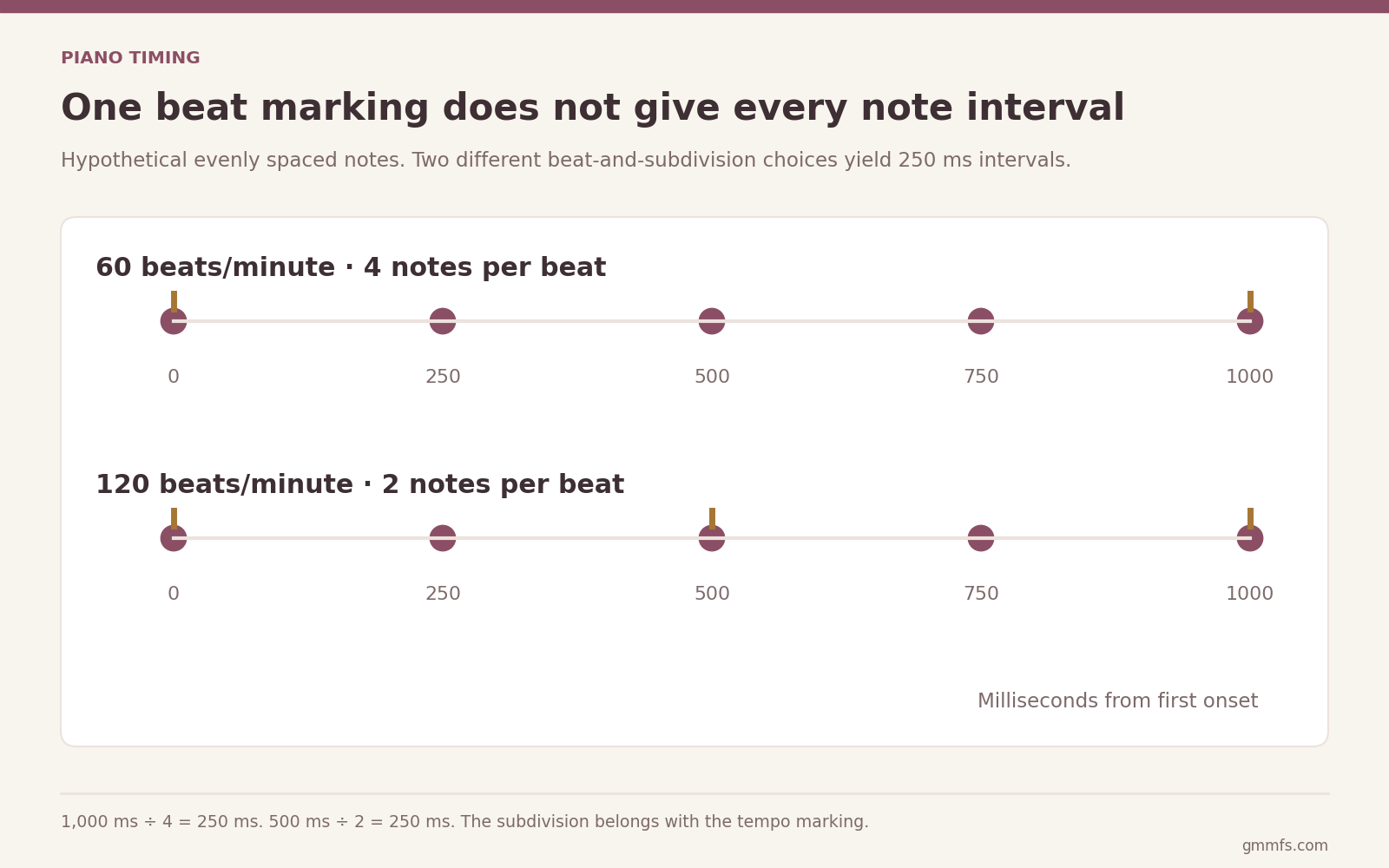
Tempo gives a musical time reference. When a metronome is set to sixty beats per minute, one beat occupies one second. At one hundred and twenty beats per minute, that interval is half a second. These are arithmetic relationships, not instructions about an appropriate practice speed.
The notes being played may occur more often than the beats. Four evenly spaced notes within each beat at sixty beats per minute begin a quarter of a second apart. Two notes per beat at one hundred and twenty have the same spacing. The written pattern and the chosen beat therefore matter together.
A useful practice note records both: “four notes per beat at sixty” is clearer than “played at sixty.” If another musician cannot reconstruct the intended rhythm from the note, the number alone does not capture the task.
Finger height and key velocity describe different movements
Finger height is a spatial measurement relative to a reference, such as the key surface. Velocity describes how position changes with time. Neither term is simply another name for force, and neither is a complete description of the resulting musical expression.
A motion-capture study of piano performance at different rates recorded finger movements while pianists played memorised melodies. Finger height before a keystroke increased with tempo, but the researchers did not interpret that pattern as merely a strategy for increasing key velocity. Their results illustrate why movement variables should be studied separately rather than compressed into a single judgment about technique.
For a reader watching a performance video, the distinction is practical. A camera shows a particular viewpoint with a particular frame rate. It can reveal where a movement occurred, but it does not directly report every force, sound characteristic or physiological demand involved.
It is also possible to mistake a visual feature for the cause of an audible one. Two events appearing together in a clip do not establish which produced the other, or whether both reflect a third change in the phrase.
A simple timing example
Consider an invented four-note pattern with onsets at zero, a quarter, a half and three quarters of a second. The spacing is regular. Now keep those same onsets but imagine that the third note is played with a different key velocity.
The timing pattern is still regular even though another property changed. Conversely, keep the key velocities alike but delay the third onset. The timing has changed even though the chosen velocity values have not. This is a conceptual example, not a recording of an actual pianist.
| Question | Relevant observation | What it does not supply by itself |
|---|---|---|
| When did the notes begin? | Onset times and intervals | The complete movement producing them |
| How did a finger move? | Position and motion over time | A direct measurement of every tissue load |
| What did the listener hear? | The resulting sound in a listening context | A unique explanation of the player’s movement |
The point is not to measure everything during ordinary practice. It is to choose the observation that matches the question. A timing problem needs a timing description before a proposed explanation can be assessed.
Hearing the result is part of the task
Playing also involves feedback. A study of six pianists and altered auditory feedback changed the timing, pitch or loudness of individual tones during short excerpts. A delayed tone was followed by a shorter interval before a subsequent keystroke, with the response depending on tempo. The experiment shows that changing what players hear can influence later actions within a sequence.
That does not mean an everyday mistake has the same cause as an experimentally altered tone. It means the performance is more than a series of isolated finger commands. The heard result and the next action are connected within an ongoing task.
When comparing practice recordings, note whether the listening conditions changed. Different headphones, monitoring delays or instrument settings may complicate the comparison. Documenting those conditions is a practical way to avoid assigning every audible difference to the hands.
Choose one question for a short comparison
Suppose a passage sounds uneven. First define what uneven means in that particular case. Are note starts irregular? Is one note unexpectedly prominent? Does the phrase lose its intended shape even when the attacks line up?
Choose a short section that contains the issue and keep a written description of the intended result. Compare a small number of recordings with the same instrument and playback setup. This is an editorial observation exercise, not a formal experiment or a prescription for a particular technique.
- Write the musical unit, including the subdivision of the beat.
- Identify the exact notes or transition that prompted the question.
- Decide whether you are comparing timing, sound or visible movement.
- Keep separate notes for what you observed and what you think caused it.
- Discuss technique changes with a teacher who can see and hear the whole task.
A statement such as “the third onset was later in this recording” is narrow but useful. “My fingers are too slow” is broader and may conceal several different possibilities.
Movement science is useful without becoming a score for the body
Research measurements help explain how musical actions can be studied. They do not provide a universal ideal finger height or a diagnosis from a video. A comfortable, effective movement for one musical situation cannot be reduced to a single impressive-looking number.
Use the vocabulary to improve the question you bring to practice. Tempo concerns timing; finger kinematics concern motion; key velocity describes a property of the key’s movement; the heard phrase is the musical result. Seeing how these fit together makes both the music and the underlying biology easier to discuss.
