Unite Under the Harmony of the Great Mountains
Welcome to the Great Mountains International Music Festival and School (GMMFS), where the world’s most promising talents and celebrated maestros come together under the majestic canopy of the Great Mountains. Our festival and school stand as a beacon of excellence in the international music community, offering a unique blend of performances, masterclasses, and educational opportunities. Join us in a celebration of music, learning, and cultural exchange in one of the most breathtaking settings on the planet.


About Us
Our Mission
At GMMFS, we are dedicated to fostering the next generation of musical talent while providing an unparalleled experience for our audience. Our mission is to create a nurturing environment for students and artists to grow, collaborate, and inspire each other, bridging cultures and genres in a symphony of diversity and unity.
Our History
Founded in 2004, GMMFS has quickly risen to prominence, attracting participants and audiences from across the globe. What started as a small gathering of music enthusiasts has transformed into a world-renowned event, celebrated for its commitment to excellence, innovation, and the promotion of global musical heritage.
Programs
For Students
- Masterclasses: Learn from the world’s leading musicians through a series of masterclasses and workshops designed to hone your craft and inspire your artistic voice.
- Performance Opportunities: Showcase your talent on an international stage, with performance opportunities that include solo recitals, chamber concerts, and orchestral performances.
- Cultural Exchange: Engage in a rich cultural exchange, sharing your music and experiences with fellow students from around the globe.
For Audiences
- Concert Series: Experience world-class performances in an intimate setting, featuring a mix of classical masterpieces, contemporary works, and premieres by today’s leading composers.
- Lectures and Seminars: Dive deeper into the music with talks and seminars by our distinguished faculty and guest artists, exploring the stories behind the music and the art of performance.
- Community Engagement: Participate in outreach programs designed to bring music to the broader community, including educational workshops and free public concerts.
Schedule
The Great Mountains International Music Festival and School. For a detailed schedule of events, masterclasses, and performances, please visit our Schedule Page.

Apply
For Students
Join a community of passionate and talented musicians. Applications for the upcoming season are now open. Find more information and apply here.
For Volunteers
Become a part of the GMMFS family. We are always looking for enthusiastic volunteers to help make our festival a success. Learn more about volunteer opportunities here.
Sponsored Content from Our Partners and Supporters
Piano Tempo, Key Velocity and Finger Movement: Three Different Measurements
A pianist can play a passage faster without intending it to sound louder. A finger can also move farther above a key without producing the change in tone that an observer expects. These are reminders that tempo, movement and sound belong to different measurements.
Keeping those measurements separate makes a practice discussion more useful. Instead of saying that a hand looks fast or heavy, ask which event is being described: the time between notes, the movement before contact, the key’s motion or the sound that follows.
Tempo describes the timing of events
Tempo gives a musical time reference. When a metronome is set to sixty beats per minute, one beat occupies one second. At one hundred and twenty beats per minute, that interval is half a second. These are arithmetic relationships, not instructions about an appropriate practice speed.
The notes being played may occur more often than the beats. Four evenly spaced notes within each beat at sixty beats per minute begin a quarter of a second apart. Two notes per beat at one hundred and twenty have the same spacing. The written pattern and the chosen beat therefore matter together.
A useful practice note records both: “four notes per beat at sixty” is clearer than “played at sixty.” If another musician cannot reconstruct the intended rhythm from the note, the number alone does not capture the task.
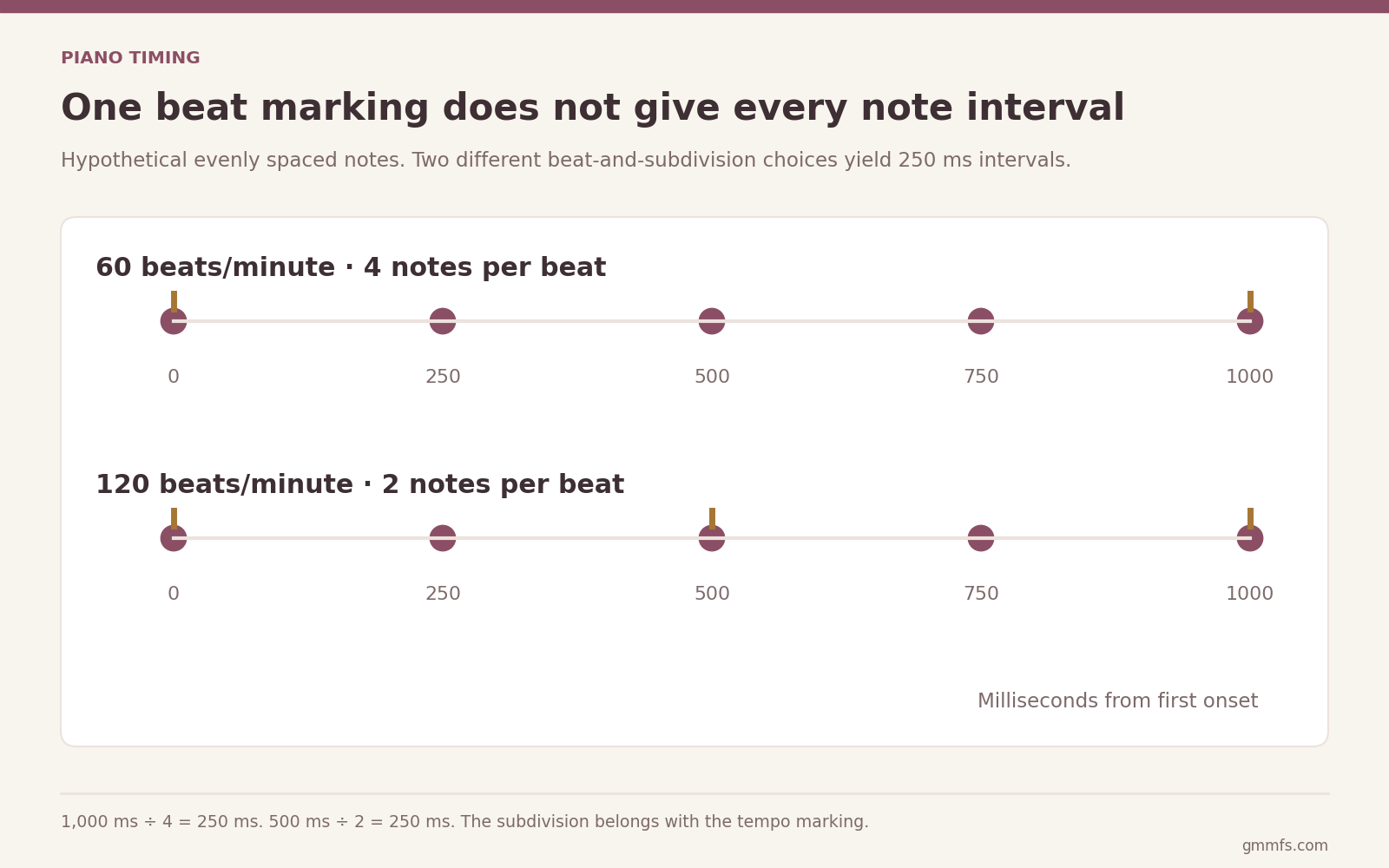
Hypothetical timing example: the note subdivision belongs alongside the tempo marking. Image credits. Finger height and key velocity describe different movements
Finger height is a spatial measurement relative to a reference, such as the key surface. Velocity describes how position changes with time. Neither term is simply another name for force, and neither is a complete description of the resulting musical expression.
A motion-capture study of piano performance at different rates recorded finger movements while pianists played memorised melodies. Finger height before a keystroke increased with tempo, but the researchers did not interpret that pattern as merely a strategy for increasing key velocity. Their results illustrate why movement variables should be studied separately rather than compressed into a single judgment about technique.
For a reader watching a performance video, the distinction is practical. A camera shows a particular viewpoint with a particular frame rate. It can reveal where a movement occurred, but it does not directly report every force, sound characteristic or physiological demand involved.
It is also possible to mistake a visual feature for the cause of an audible one. Two events appearing together in a clip do not establish which produced the other, or whether both reflect a third change in the phrase.
A simple timing example
Consider an invented four-note pattern with onsets at zero, a quarter, a half and three quarters of a second. The spacing is regular. Now keep those same onsets but imagine that the third note is played with a different key velocity.
The timing pattern is still regular even though another property changed. Conversely, keep the key velocities alike but delay the third onset. The timing has changed even though the chosen velocity values have not. This is a conceptual example, not a recording of an actual pianist.
Three questions that can be asked about the same passage Question Relevant observation What it does not supply by itself When did the notes begin? Onset times and intervals The complete movement producing them How did a finger move? Position and motion over time A direct measurement of every tissue load What did the listener hear? The resulting sound in a listening context A unique explanation of the player’s movement The point is not to measure everything during ordinary practice. It is to choose the observation that matches the question. A timing problem needs a timing description before a proposed explanation can be assessed.
Hearing the result is part of the task
Playing also involves feedback. A study of six pianists and altered auditory feedback changed the timing, pitch or loudness of individual tones during short excerpts. A delayed tone was followed by a shorter interval before a subsequent keystroke, with the response depending on tempo. The experiment shows that changing what players hear can influence later actions within a sequence.
That does not mean an everyday mistake has the same cause as an experimentally altered tone. It means the performance is more than a series of isolated finger commands. The heard result and the next action are connected within an ongoing task.
When comparing practice recordings, note whether the listening conditions changed. Different headphones, monitoring delays or instrument settings may complicate the comparison. Documenting those conditions is a practical way to avoid assigning every audible difference to the hands.
Choose one question for a short comparison
Suppose a passage sounds uneven. First define what uneven means in that particular case. Are note starts irregular? Is one note unexpectedly prominent? Does the phrase lose its intended shape even when the attacks line up?
Choose a short section that contains the issue and keep a written description of the intended result. Compare a small number of recordings with the same instrument and playback setup. This is an editorial observation exercise, not a formal experiment or a prescription for a particular technique.
- Write the musical unit, including the subdivision of the beat.
- Identify the exact notes or transition that prompted the question.
- Decide whether you are comparing timing, sound or visible movement.
- Keep separate notes for what you observed and what you think caused it.
- Discuss technique changes with a teacher who can see and hear the whole task.
A statement such as “the third onset was later in this recording” is narrow but useful. “My fingers are too slow” is broader and may conceal several different possibilities.
Movement science is useful without becoming a score for the body
Research measurements help explain how musical actions can be studied. They do not provide a universal ideal finger height or a diagnosis from a video. A comfortable, effective movement for one musical situation cannot be reduced to a single impressive-looking number.
Use the vocabulary to improve the question you bring to practice. Tempo concerns timing; finger kinematics concern motion; key velocity describes a property of the key’s movement; the heard phrase is the musical result. Seeing how these fit together makes both the music and the underlying biology easier to discuss.
The Fascinating Link Between HGH and Gourmet Food
Cinnatropin Human Growth Hormone (HGH) for sale is well-known for its role in muscle growth, metabolism, and anti-aging. An emerging and intriguing topic is its connection to gourmet food, with researchers and chefs exploring how specific diets can naturally boost HGH production and how HGH-enhancing foods can elevate the fine dining experience. For those interested in supplementation, it’s important to buy real HGH online from trusted, verified sources to ensure safety and authenticity.

The Role of Nutrition in HGH Production
Diet plays a crucial role in stimulating natural HGH production. Gourmet food, with its emphasis on high-quality, nutrient-dense ingredients, can support optimal hormone levels.
Essential Nutrients for HGH Stimulation
Certain amino acids, vitamins, and minerals found in gourmet foods are linked to increased HGH secretion. Foods rich in arginine, glutamine, and melatonin—such as grass-fed meats, aged cheeses, and organic dark chocolate—can naturally boost HGH production.
Superfoods in High-End Cuisine
Luxury ingredients like caviar, truffles, and wild-caught seafood are not only delicacies but also contribute to metabolic balance and hormone regulation. These ingredients provide antioxidants, omega-3 fatty acids, and other compounds that support HGH levels.
HGH-Optimized Gourmet Diets
Top chefs and nutritionists are collaborating to create gourmet menus designed to enhance HGH production, merging the worlds of fine dining and biohacking.
The Rise of Functional Gastronomy
The gourmet food industry is embracing functional gastronomy, where dishes are crafted to maximize both flavor and health benefits. Restaurants specializing in HGH-friendly cuisine incorporate nutrient-dense foods that stimulate hormone production.
Luxury Wellness Retreats and HGH-Boosting Cuisine
Elite wellness retreats are now offering gourmet meal plans specifically designed to enhance natural HGH levels. These menus focus on whole foods, intermittent fasting-friendly dishes, and nutrient-rich superfoods that support overall vitality.
The Future of HGH and Gourmet Food
As the intersection of science and gastronomy expands, HGH is becoming a focal point in the gourmet food industry.
Personalized HGH Diet Plans
Advancements in biotechnology and personalized nutrition are paving the way for custom-tailored gourmet meal plans that optimize HGH production based on individual biomarkers and genetic analysis. In a similar vein, individuals seeking to manage their weight or control diabetes can now order Semaglutide hassle-free, which supports weight loss and helps in regulating blood sugar levels.
Ethical Considerations and Culinary Innovation
As the use of HGH in food-related wellness trends grows, ethical debates arise over hormone enhancement and natural health approaches. Meanwhile, culinary innovators continue to explore ways to blend luxury dining with scientifically-backed nutrition.
The link between HGH and gourmet food is a fascinating blend of science, nutrition, and high-end culinary artistry. As awareness grows, more chefs and health experts are embracing this synergy to redefine the future of fine dining and well-being.
The Role of Dianabol for Sale in the Early Era of Bodybuilding

Bodybuilding, a sport synonymous with discipline, nutrition, and intense training regimes, has long been a platform for athletes to sculpt physiques showcasing peak human strength and aesthetics. However, the early years of competitive bodybuilding saw a paradigm shift with the introduction of performance-enhancing drugs (PEDs), among which Dianabol was prominent. This article explores the impact of Dianabol in the foundational years of bodybuilding, its influence on the sport, and the ensuing controversies.
Introduction to Dianabol
Dianabol, chemically known as methandrostenolone, is an anabolic steroid initially synthesized by Dr. John Ziegler in the 1950s. It was developed to help the U.S. Olympic Team compete against the Soviet athletes, who were then dominating the games thanks to their use of testosterone. By orally administering Dianabol, athletes could avoid the complications of frequent injections and still gain significant muscle mass and strength. This advantage was soon picked up by bodybuilders who sought dramatic improvements in their physique and performance.
Dianabol’s Entry into Bodybuilding
During the 1960s and 1970s, often dubbed the “Golden Era” of bodybuilding, legends like Arnold Schwarzenegger and Sergio Oliva emerged, shaping the sport into what we know today. It was also in this period that the use of Dianabol for sale became prevalent in gyms, helping athletes make remarkable strides in their physique development. Known for its fast-acting effects on muscle growth, recovery, and performance, this steroid played a pivotal role in allowing bodybuilders to achieve extraordinary results in a fraction of the time, something that traditional training methods alone could not deliver.
Dianabol’s ability to enhance protein synthesis and promote nitrogen retention in muscle tissues made it an essential part of many bodybuilders’ training regimens. It enabled athletes to push their limits, train more intensely, and recover faster, providing a crucial edge in a sport where both aesthetic appeal and functional strength are paramount. For those looking to explore options like Dianabol, the Mister Olympia shop offers a trusted source for top-quality steroids to enhance your performance.
Ethical and Health Concerns
Despite its popularity, the use of Dianabol was not without controversy. The early adopters were pioneers in a largely unregulated space of supplement and drug use in sports. There was little understanding of the long-term health implications or the ethical considerations of using steroids.
By the late 1970s, reports of adverse effects began to surface. Bodybuilders experienced issues ranging from liver damage to cardiovascular problems, and even hormonal imbalances that could lead to more severe health issues. The medical community started to document these impacts comprehensively, leading to a growing call for regulation.
In response to the mounting evidence of harm and the broader ethical concerns regarding PED use in sports, the U.S. Congress passed the Anabolic Steroid Control Act in 1990. This legislation classified many steroids, including Dianabol, as controlled substances. This marked a significant turn in the regulation of steroids in sports, including bodybuilding. However, despite legal restrictions, steroids for sell can still be found on the black market, posing serious risks to users due to questionable quality and lack of oversight.
Legacy and Modern Perspective
The legacy of Dianabol continues to influence the bodybuilding community. Modern bodybuilders are much more aware of the health risks associated with steroid use and are subject to more rigorous testing procedures. However, the quest for maximum performance and physique enhancement still tempts many to explore such substances, albeit more cautiously. As a result, some athletes research dbol pills for sale, seeking ways to enhance muscle growth while navigating evolving regulations and safety concerns.
Today, discussions around Dianabol in bodybuilding are also framed within a larger conversation about health, ethics, and the future of the sport. While the golden era of bodybuilding was marked by less regulation and more experimentation, the current era might be seen as one seeking a balance between human potential and safety.
Conclusion
The role of Dianabol for sale in early bodybuilding was undeniably profound. It helped shape the outcomes of many competitions and influenced the standards of what was considered achievable in muscle development. Even today, dbol pills remain a popular choice among bodybuilders aiming for rapid muscle gains and improved strength. As the sport continues to evolve, the lessons learned from the era of Dianabol remain critical. They remind the sporting world of the need to balance ambition with ethical considerations and health.
References
- “Dianabol and Its Impact on Bodybuilding” – Link to reference
- “Health Risks of Steroids in Early Bodybuilding” – Link to reference
- “The Anabolic Steroid Control Act and Its Effects on Sport” – Link to reference
In summary, while Dianabol significantly contributed to the advancements in bodybuilding, it also ushered in a more cautious approach to performance enhancement in the sport, reflecting the broader societal values towards health and fair play.
Support Us

Become a Patron
Your support ensures the continued success and growth of GMMFS. Learn about patron benefits and how you can contribute to the future of music here.
Sponsorship Opportunities
Align your brand with excellence and innovation. Discover the benefits of becoming a GMMFS sponsor here.
Contact Us

For more information about the Great Mountains International Music Festival and School, please contact us at email or visit our Contact Page.
Join us at GMMFS for an unforgettable journey through the world of music, set against the stunning backdrop of the Great Mountains. Whether you’re a student, a professional musician, or a music lover, there’s a place for you here. Let’s celebrate the power of music together.
Follow Us on Social Media


Stay connected and get the latest updates on our programs, events, and more through our social media channels: Facebook, Twitter, Instagram.
Welcome to the Great Mountains International Music Festival and School – where music meets the mountains.
Great Mountains International Music Festival & School
Harmonizing Talent, Nature, and Cultures